
Local business · 5 min read
Solar and EV Charger Installer Websites for a Grant-Driven Market
Solar and EV installers compete on one question before price ever comes up: can I get help paying for this. Here's how to build a site that answers it fast.
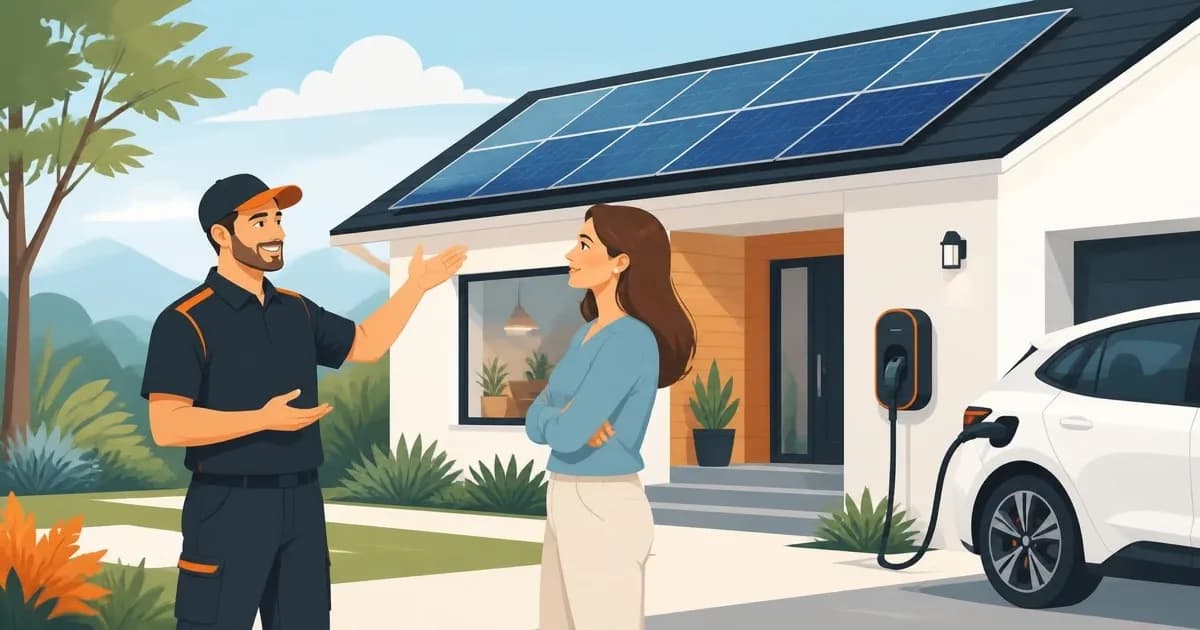
We quote solar and EV charger installers more than almost any other trade right now, and every single one starts the conversation the same way: "our leads keep asking about grants and we don't know how to put that on the site." That hesitation is costing them the call. A homeowner researching solar has already decided the technology works. What they haven't decided is whether they can afford it, and whether this particular installer is the one who understands the funding landscape well enough to get them through it without surprises.
That changes what the homepage has to do. It's not selling panels or chargers. It's answering a money question fast enough that the visitor trusts you with the harder conversation, which is the survey booking.
The grant question decides whether they call you
In the UK, residential solar installations have carried 0% VAT since April 2022, extended through March 2027 under current government policy. In the US, the federal residential Investment Tax Credit covers 30% of system cost for installations through 2032 under the Inflation Reduction Act, stepping down after. Both of these are real, checkable numbers, and both change the economics of a quote enough to decide whether someone proceeds. If your site doesn't state the current incentive plainly, in the visitor's own country's terms, they'll leave to find a competitor's site that does, and that competitor gets the enquiry.
We see installer sites bury this in a PDF linked from a footer, or worse, leave it out entirely because "it changes too often to keep updating." That's backwards. A dated, clearly-labelled incentive summary ("current as of October 2026") builds more trust than silence, because it signals you're actively tracking the policy, not guessing.
| Weak installer site | Strong installer site |
|---|---|
| Grants mentioned once, in a blog post from last year | Current incentive summary on the homepage, dated and specific to the visitor's region |
| Certifications listed in small print in the footer | MCS, NICEIC or equivalent badges visible above the fold on every page |
| Generic "get a quote" form with no filtering | Short eligibility quiz that filters by roof type, postcode or EV ownership before the call |
| Stock photography of panels on a roof | Real installation photos with before/after and the installer's own team visible |
Certification badges do more work than price
Solar and EV installs are exactly the kind of purchase where buyers are afraid of being burned, because they've read stories about cowboy installers taking deposits and vanishing, or installs that invalidate a roof warranty. Trade certification (MCS for solar in the UK, NABCEP in the US, NICEIC for electrical work tied to EV charger installs) is the single fastest way to defuse that fear, but only if it's visible before the visitor has to go looking for it. We put certification badges in the header or directly under the hero on every installer site we build, not on a dedicated "Accreditations" page nobody clicks through to.
The EV charger upsell most solar sites miss
A homeowner getting solar quoted is one of the easiest EV charger conversations you'll ever have, because the electrician is already on site and the panel upgrade conversation is already happening. We've watched installer sites treat solar and EV chargers as two separate services with two separate pages and no cross-link between them, which means a visitor booking a solar survey never even sees that the charger is an option, let alone an easy add-on. One line on the solar page ("already have or planning an EV? Ask about adding a charger to the same install") with a link through to the EV page captures that upsell before the quote conversation even starts.
What a survey-booking funnel actually needs
- A postcode or address field early, since serviceable area and local grid capacity affect what's possible
- A rough system size or usage estimator so the quote isn't a total guess for either side
- Clear separation between a free survey and any paid assessment, stated upfront
- A finance/incentive summary that's dated and region-specific, not a single generic page
- Photos and a short write-up of installs completed in the visitor's own area if you have them
None of this needs to be complicated to build. It needs to be structured so the funding question gets answered in the first screen, not the fifth. That's a web development problem more than a design one: it's about what content sits where and how fast the eligibility and trust signals load, not how many animations the hero section has.
We've built this exact structure for installers in grant-sensitive markets before, and the pattern holds: sites that answer the money question first get more qualified survey bookings, not just more traffic. A visitor who already understands the incentive and sees the certification badge is calling to book, not to ask questions you could have answered on the page.
Questions people also ask
Do I need to update my website every time a grant or incentive changes?
Yes, but it doesn't need to be complicated. A single dated incentive summary block that you update when the policy changes is enough. What matters is that it's current and clearly labelled with a date, so visitors trust it over a competitor's outdated page.
Where should certification badges go on an installer website?
Above the fold, ideally in the header or directly below the hero section, on every page. Burying MCS, NICEIC or NABCEP badges on a separate accreditations page means most visitors never see them before deciding whether to trust you.
Should solar and EV charger installs be on the same page or separate pages?
Separate pages for SEO and clarity, but cross-linked explicitly. A homeowner booking a solar survey should see a clear prompt to add an EV charger to the same install, since the electrician is already on site either way.