
SEO · 7 min read
Why one page cannot rank for ten services
Google ranks pages, not businesses. If your ten services share one page, you have entered one competitor into ten races and asked it to win them all.
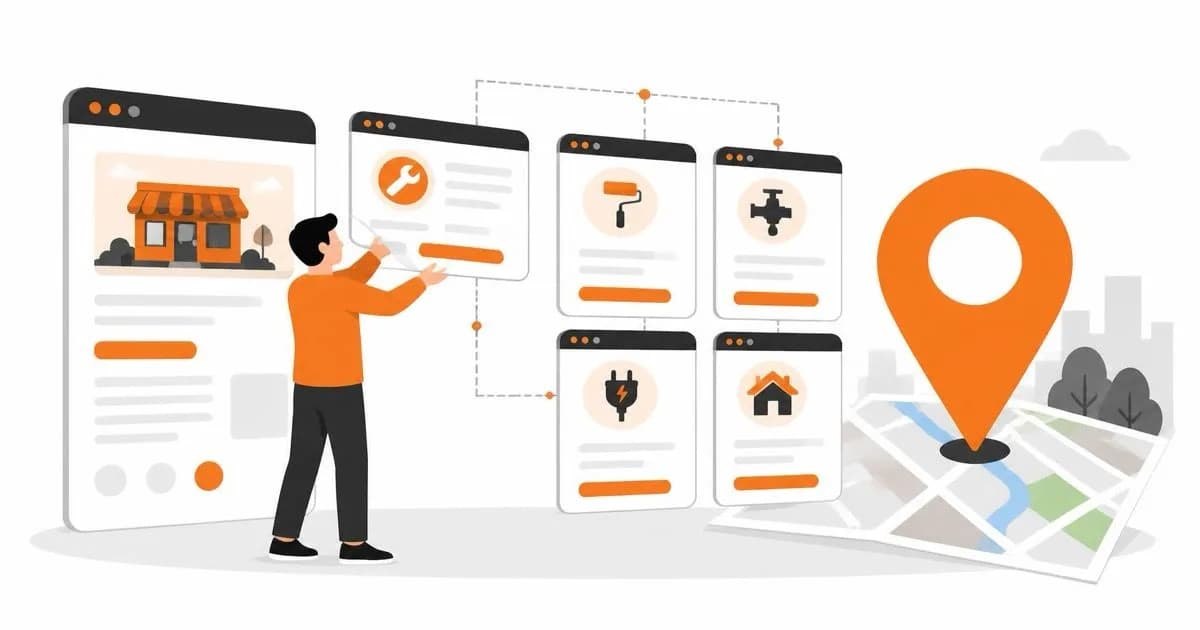
Here is the single most common structural mistake on small business websites. The business offers ten services. The website has one page called Services with ten bullet points on it. The owner cannot understand why they do not rank for any of them.
The reason is simple once you see it: Google ranks pages, not businesses. When somebody searches for a specific job in a specific town, Google looks for the page that best answers that exact question. Your bullet point is competing against somebody else's entire page.
What a real service page contains
A page that wins that comparison is not long for the sake of it. It is specific. Ours contain:
- A heading that matches how people search. Not 'Our Diagnostics Offering' but the words a customer would type.
- What the job involves, in plain language, including how long it takes.
- A price, or an honest range. 'From £89' beats 'contact us for pricing' every time. People filter out businesses that will not talk about money.
- Your own photos of that specific work. Stock images of somebody else's workshop actively hurt.
- Reviews from customers who bought that service, not your general five best reviews repeated everywhere.
- The questions you get asked on the phone, answered on the page. If you say it ten times a week, write it down once.
- One clear next step. Call, WhatsApp or book. Not all three competing for attention in the same place.
That page can now compete for its own search, and it converts better as well, because someone who lands on it has already found exactly what they wanted.
Location pages, done properly
The same logic extends to the towns you cover, with one important condition. A location page has to earn its existence. Ten pages identical except for the town name are recognised for exactly what they are and do nothing for you.
A location page that works mentions genuinely local things: the areas and postcodes you cover, how long you take to get there, jobs you have actually done nearby, reviews from customers in that town, any local detail that only applies there. If you cannot write a paragraph that is true only of that location, do not make the page.
Your Google Business Profile does half the work
For local searches, the map results often sit above everything else, and they are driven by your Google Business Profile rather than your website. The two support each other, and most businesses under-use the profile badly.
- 1Pick the most specific primary category available, then add secondary categories for your other services.
- 2List services inside the profile and link each one to its page on your site.
- 3Add real photos regularly. Profiles with recent photos get more engagement than dormant ones.
- 4Ask every satisfied customer for a review, and reply to all of them, including the unhappy ones. A calm reply to a bad review reassures readers more than a wall of perfect scores.
- 5Keep your name, address and phone number identical everywhere online. Inconsistency confuses the matching that decides local rankings.
97%
of consumers read online reviews for local businesses
Source: BrightLocal Local Consumer Review Survey, 2026
How long this takes
Local SEO is slow and then it is not. Expect very little for four to eight weeks while new pages are crawled and assessed. Movement usually starts in months two and three, and compounds from there as pages accumulate signals.
Anyone promising first place in thirty days is either buying ads and calling it SEO, or chasing search terms nobody uses. Both are easy to check: ask exactly which search terms they intend to rank you for, then search for them yourself and see whether the results look like customers.
We build sites with this structure from the start, so the service pages exist before anyone has to retrofit them. If you want to see it applied to a specific trade, our garage website pages show how it works across eight different automotive services.
Questions people also ask
How many service pages should a small business have?
One for each service you genuinely want more work from, and no more. Five strong pages you keep current beat twenty thin ones you wrote once and abandoned.
Will duplicated location pages get me penalised?
They will not usually trigger a penalty, they simply do not work. Google recognises near-identical pages and picks one to show, if any. The wasted effort is the real cost.
Do I need a blog to rank locally?
Not to rank for your core services. Service and location pages do that work. A blog helps you catch the questions people ask before they are ready to buy, which matters more in some trades than others.