
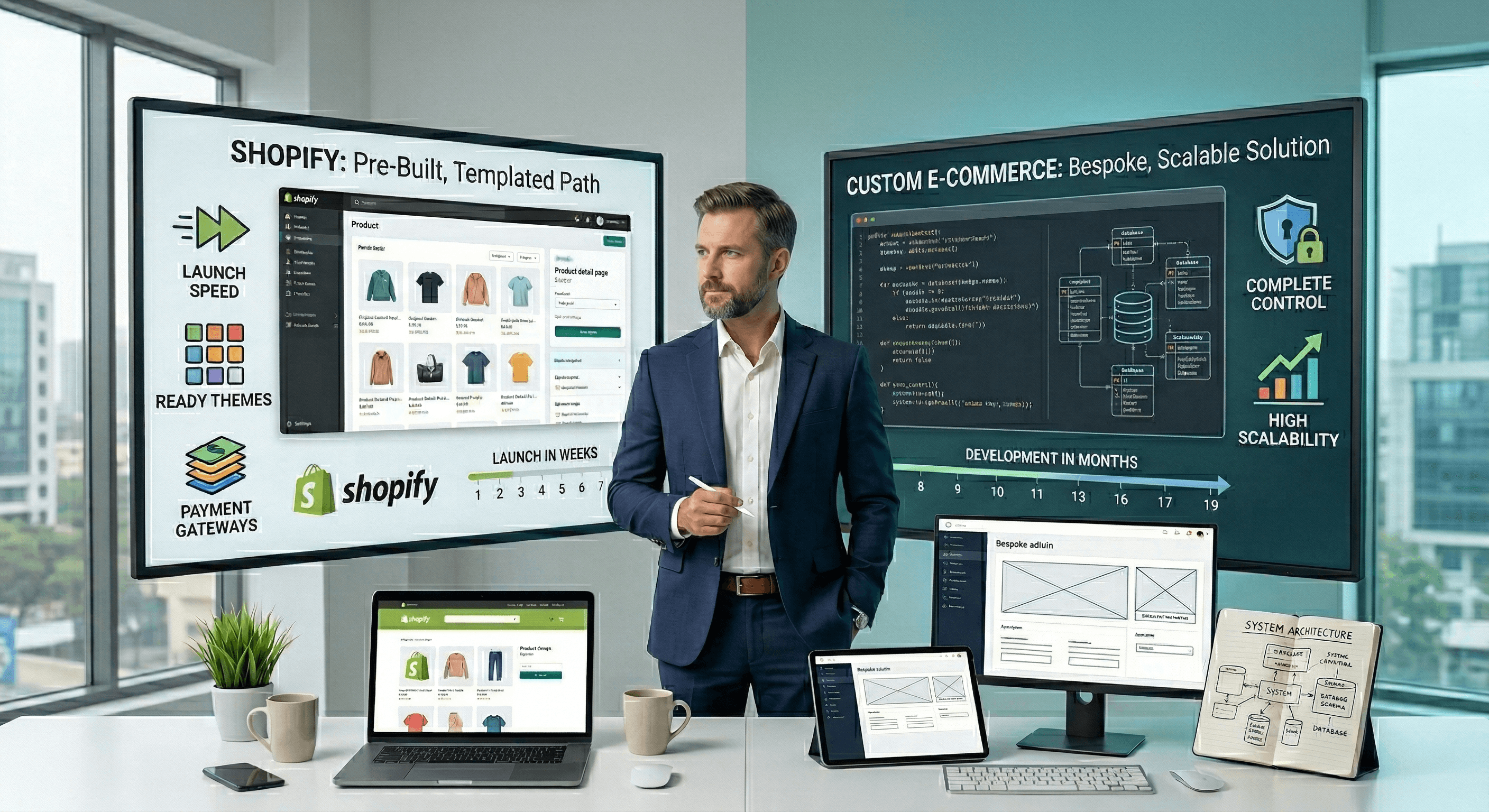
Shopify vs Custom E-Commerce: Which Is Right for Your Business?
Every e-commerce founder faces this decision at some point: go with Shopify (or WooCommerce) — battle-tested, fast to launch, easy to manage — or build something custom that fits your exact business model.
The wrong choice costs you money. Shopify can become expensive and limiting at scale. Custom can be over-engineered for a business that isn't ready for it.
Here's how to actually decide.
What Shopify Does Really Well
Shopify has earned its dominance for good reasons. For most product-based businesses, it gets 90% of what you need out of the box:
- Payment processing fully handled (Shopify Payments + every major gateway)
- Inventory management that's genuinely usable without training
- Shipping integrations with all major carriers
- Mobile-first checkout that converts — Shopify's checkout is among the best-converting in the industry
- App ecosystem — 8,000+ apps for subscriptions, reviews, loyalty programmes, upsells, and more
- Security and PCI compliance — handled entirely by Shopify, never your problem
- Hosting and uptime — enterprise-grade infrastructure you don't have to manage
For a business selling straightforward physical products — apparel, beauty, food, home goods — Shopify is almost always the right starting point. The platform is mature, the ecosystem is huge, and you can be live in days rather than months.
Where Shopify Falls Short
Shopify is a great fit — until it isn't. The cracks typically show up in four situations:
1. Complex Product Configuration
If your products have more than a handful of variants, need customer-input fields (engravings, custom sizes, made-to-order), or involve a multi-step configuration process, Shopify's default variant system becomes a workaround maze. You can patch it with apps, but you're fighting the platform rather than working with it.
2. Unusual Business Models
Shopify is built for product-first retail. If you have:
- Rental or lease models
- Subscription boxes with complex rules
- B2B with tiered pricing and approval workflows
- Digital goods with licensing or access controls
- Multi-vendor marketplace features
...you'll spend significant money on apps and custom development to approximate what a custom build would do natively.
3. Cost at Scale
Shopify's pricing scales in two ways that hurt at volume:
Monthly fees: Basic ($39) → Shopify ($105) → Advanced ($399) → Plus ($2,300+/month). Most growing businesses end up at Advanced or Plus.
Transaction fees: 0.5-2% on every transaction if you're not using Shopify Payments. If you're doing $1M/year in revenue and using a third-party gateway, you're paying $5,000-20,000 in fees annually just for the privilege.
At high volume, a custom solution's one-time development cost pays for itself in 12-18 months just in fee savings.
4. Deep Integration Requirements
If your e-commerce store needs to be deeply integrated with proprietary ERP systems, custom inventory management, external fulfilment logic, or complex business rules — Shopify's API will get you most of the way, but you'll eventually hit walls that require expensive workarounds.
What a Custom E-Commerce Build Gives You
Custom doesn't mean "built from scratch with no tools." It typically means a framework like Laravel, Next.js, or a headless commerce stack (Medusa, Vendure) with your exact business logic built in.
The advantages:
- No transaction fees — you pay Stripe or whatever gateway directly (typically 1.4-2.9% + flat fee, no platform cut)
- No monthly platform fees — your hosting costs are fixed and predictable
- Exact business model fit — the system works the way your business works, not the other way around
- Full data ownership — your customer data, your analytics, your rules
- Performance — a well-built custom store is typically faster than a theme-based Shopify store, especially on mobile
- No app dependency — every feature is native, not a third-party plugin that can break or be discontinued
The disadvantages:
- Higher upfront cost — a proper custom e-commerce build starts at $8,000-15,000 and goes up from there
- Longer to launch — 6-16 weeks vs 2-4 weeks for Shopify
- You own maintenance — security updates, server management, bug fixes are your responsibility
- Shopify's checkout is hard to beat — their checkout conversion rate has years of optimisation behind it
The Hybrid Approach: Headless Shopify
There's a middle path worth knowing about: headless commerce.
You keep Shopify's backend (inventory, payments, checkout, order management) but replace the frontend with a custom-built Next.js or Nuxt storefront. You get:
- Shopify's reliable infrastructure and checkout
- Completely custom frontend with no theme limitations
- Better performance (typically 90+ Lighthouse scores)
- Full design freedom
The downside is cost — headless builds typically start at $15,000+ — and you still pay Shopify fees. But for brands that need a bespoke experience without rebuilding the entire commerce infrastructure, it's a strong option.
Decision Framework
Choose Shopify if:
- You're launching your first e-commerce business
- You sell straightforward physical products
- You want to be live in weeks, not months
- Your annual revenue is under $500K
- You don't have unusual business model requirements
Choose a custom build if:
- You're doing $500K+ in annual revenue and platform fees are material
- Your business model doesn't fit neatly into Shopify's paradigm
- You need deep integration with existing business systems
- You need features that Shopify's app ecosystem can't provide cleanly
- You're building a marketplace or multi-vendor platform
Choose headless if:
- You want Shopify's reliability with complete frontend freedom
- You're a brand where design and performance are core to the product experience
- You have a development team or budget to support it
The Real Cost Comparison Over 3 Years
Let's take a $500K/year revenue business:
Shopify Advanced:
- Platform: $399/month × 36 = $14,364
- Transaction fees (0.5% if using third-party gateway): $7,500
- Apps (reviews, subscriptions, etc.): ~$300/month × 36 = $10,800
- Initial theme + setup: $3,000
- Total 3-year cost: ~$35,664
Custom build:
- Initial development: $15,000
- Hosting (VPS, $100/month): $3,600
- Maintenance retainer: $200/month × 36 = $7,200
- Payment processing (Stripe 1.5% blended): $22,500 (same as Shopify Payments)
- Total 3-year cost: ~$25,800
The custom build saves $10,000 over three years at this revenue level — more if you're on a third-party gateway on Shopify, more still if you avoid multiple apps.
At $100K/year in revenue, the math reverses and Shopify wins easily.
We build both Shopify stores and custom e-commerce platforms, depending on what's right for the business. If you're trying to figure out which path makes sense for you, book a free call and we'll map it out with you — including a realistic cost comparison for your specific situation.
Fakhar Zaman
Founder & CEO, Lipsum Technologies
Have a Project in Mind?
Book a free 30-minute call and we'll figure out the best way to move forward — no pressure, no obligation.
Send us a message
We'll get back to you within 24 hours.